


A few years ago, if someone wanted to buy a new bag, lipstick, protein powder, or phone, they would probably search for it on Google, walk into a store, or ask a friend for recommendations. Today, that decision is increasingly shaped by a creator sitting in their bedroom talking to a phone camera.
A girl in Mumbai posts a reel about the lip tint she carries everywhere. A college student in Kochi shares links to the oversized shirts he keeps getting asked about. A mother in Jaipur reviews storage containers that made her kitchen feel less chaotic.
None of them sound like salespeople or look like ads. Yet all of them are shaping what people buy.
This is how India shops now. Through people they follow, trust, and feel connected to.
But while the creator economy has exploded culturally, one problem has remained unsolved: attribution. Did the reel actually cause the sale?
Brands poured money into influencer campaigns, collected reports filled with views and engagement, and still struggled to connect content to commerce. Creators were paid for reach. Brands hoped for results. And somewhere between a comment and a checkout, value was lost in translation.
LehLah was built to close that gap. To turn creator-led commerce into something measurable, structured, and scalable by connecting content directly to sales.
Solving the Monetisation Problem
Despite rapid growth, monetisation in India’s creator economy has remained uneven.
A small set of creators secure large sponsorships, while thousands with highly engaged audiences struggle to build stable income streams. At the same time, brands are becoming more performance-driven with marketing spend.
Follower counts are no longer enough. Brands want clarity on which creators actually drive purchases, which campaigns convert, and how creator-led commerce can move from visibility-driven to outcome-driven.
LehLah, founded by Ashna Ruia, sits directly in this shift.
Creators use the platform to share affiliate links for products they genuinely recommend across beauty, fashion, lifestyle, wellness, and more. When a purchase happens through those links, creators earn a commission. Brands pay only when sales are made.
The alignment is simple: creators earn through trust, brands pay for outcomes, and consumers discover products through voices they already follow.
More importantly, it allows creators to monetise consistently without relying on repeated brand collaborations or one-off deals.
Built for the Indian Internet
LehLah’s model reflects how India actually discovers and buys online.
Discovery is not driven by polished campaigns. It starts with familiarity — someone who speaks your language, understands your budget, and shows how a product fits into everyday life.
A regional fashion creator styling affordable outfits for work. A skincare creator explaining humidity-friendly routines. A student reviewing budget tech. These voices often influence purchase decisions more than national campaigns ever can.
Today, more than 5 lakh creators across Tier 1, 2, and 3 cities are onboarded on LehLah, collectively publishing over 2 lakh content pieces every month in Hindi, English, and multiple regional languages. Together, this ecosystem is already driving close to ₹200 crore in annual GMV.
For brands, this creates distribution that feels organic rather than forced. Products are not interrupting attention through ads — they are embedded inside content people already choose to watch and trust.
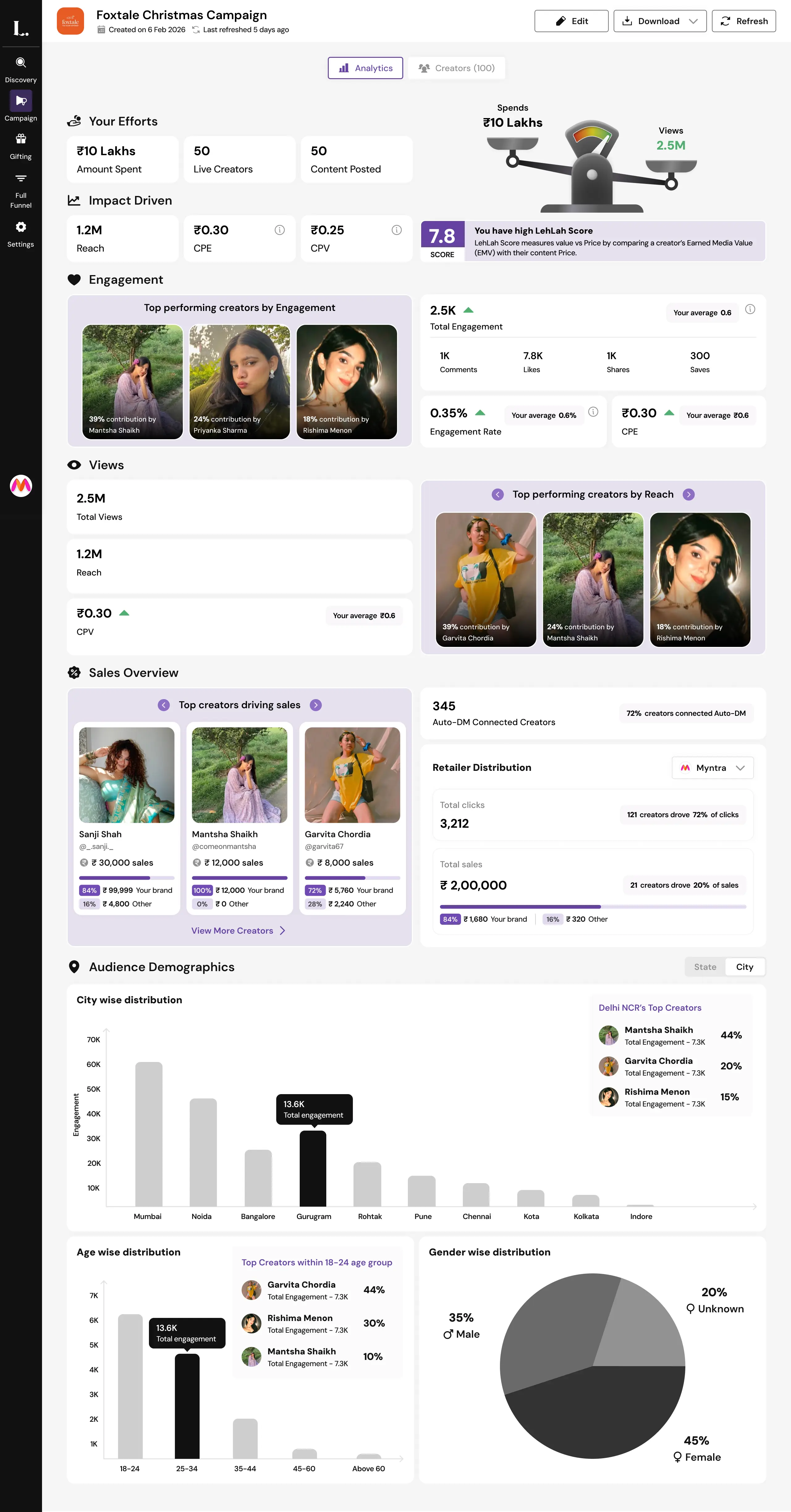
LehLah works with major platforms like Myntra, Meesho, Flipkart, and Nykaa, alongside D2C brands such as Libas and Foxtale, enabling this content-led commerce layer across categories.
The Infrastructure Under the Influence
LehLah is built at the intersection of three things: creators who have audiences, brands that want to reach them, and shoppers who are one nudge away from buying.
The model is commission-based: brands pay LehLah when sales actually happen through creators. Not when a reel gets views. Not when someone saves a post. When a purchase goes through. For brands, this is a meaningful shift because instead of paying upfront for attention and hoping it converts, they pay when it does.
The feature that makes the whole thing hum is Auto-DM. When a viewer comments on a reel, even something as simple as "where do I get this?," Auto-DM immediately sends them a personalised link to buy. The gap between intent and action shrinks to seconds. Passive interest becomes a tracked, attributable sale.
But attribution is only one half of the equation. The other is making it easier for creators to build sustainable businesses.
Beyond affiliate commerce, LehLah has also brought brand collaborations directly into the platform—addressing one of the biggest operational challenges creators face.
Traditionally, landing a brand partnership meant sending cold emails or DMs, negotiating terms over multiple conversations, and often waiting months after delivering content to get paid. For all but the largest creators, the process was fragmented and unpredictable.
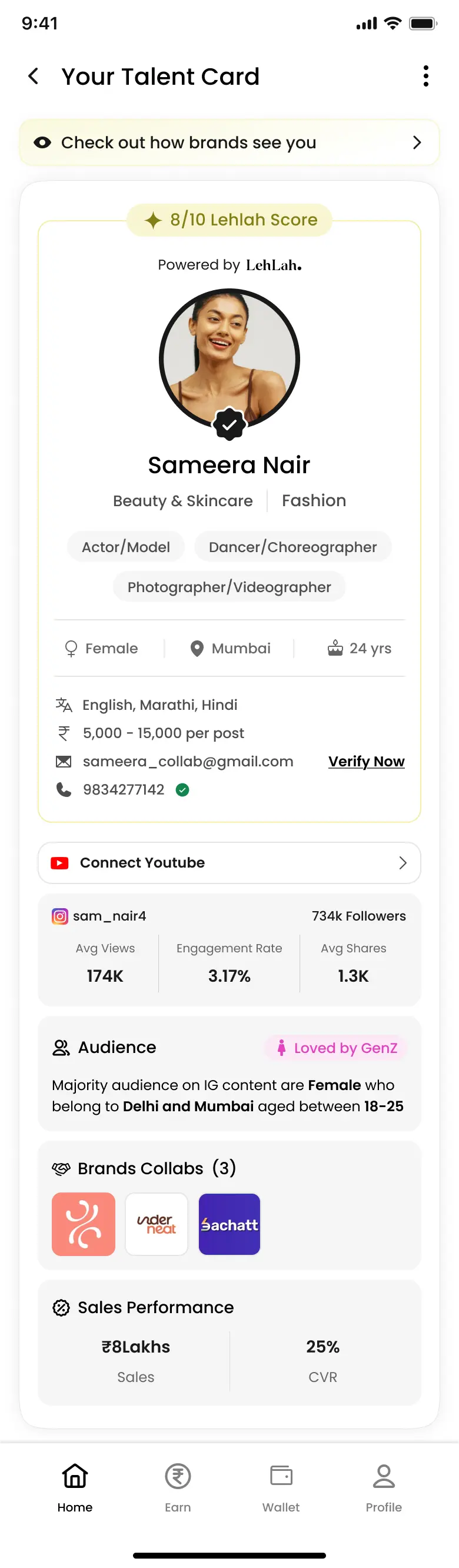
LehLah centralises that workflow. Creators can discover collaboration opportunities from brands, accept campaigns, manage deliverables, and receive payments through a single platform. Payment timelines are visible before a creator accepts a campaign, removing much of the uncertainty that has historically made sponsorship income inconsistent.
Creators onboarded with LehLah get Scriptr, a library of 1 crore+ viral scripts calibrated to brand tone and target audience, so they're never starting from a blank page. They get personal storefronts to centralise their recommendations. They get branded products delivered to them for content creation. And they get 24/7 instant withdrawals because waiting 45 days to get paid for work you did last month is a quick way to lose your best creators.
The result is a system where creators are not just producing content, but operating within a structured commerce layer.
The Bigger Picture
India has a billion scrolls happening every day. Each one is a moment of attention and increasingly, a potential transaction.
What is changing is not just content consumption, but commerce itself. The storefront is no longer a shelf or a website. It is a screen. It lives inside content. It is shaped by trust.
LehLah is building the infrastructure that makes this shift measurable and therefore scalable.
When a sale happens, everyone involved from creator and brand to platform can see the value created across the chain of influence.
At Gruhas, we back founders who build for markets before it even formalises. LehLah is building at that inflection point where creator attention is becoming a direct commerce layer — not a marketing channel.
We are proud to be building with them.